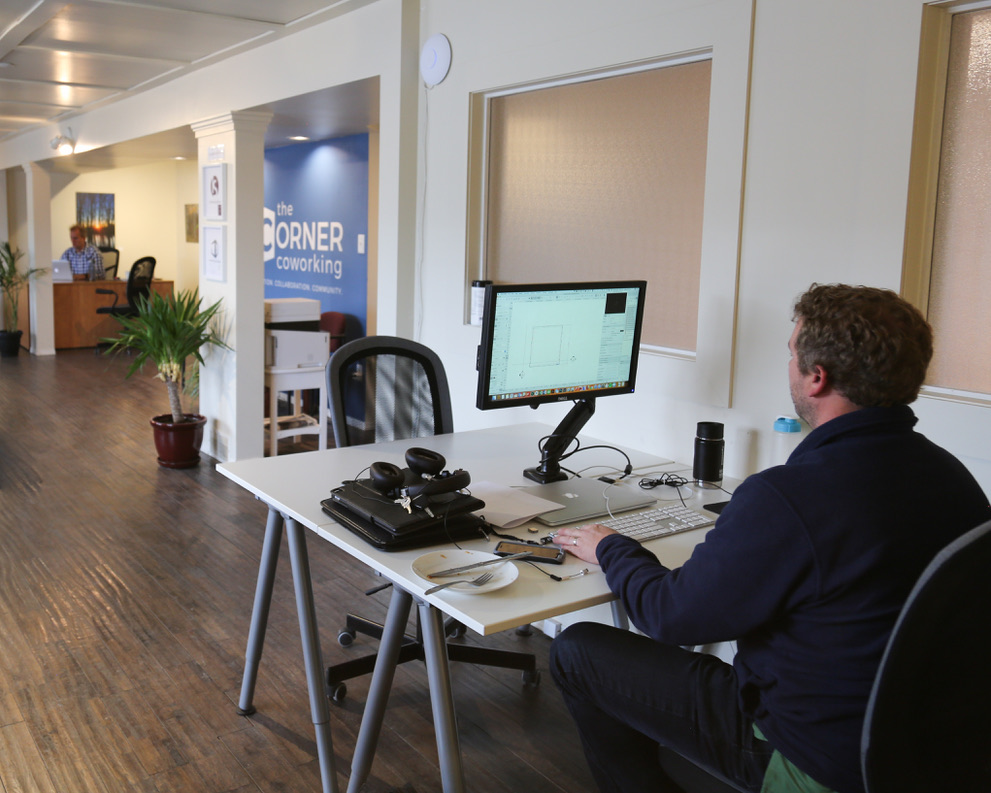
why a single month of coworking can reset your whole summer
School lets out and the house fills up. The kitchen table you used as a desk is suddenly contested territory. Your 10 a.m. call has a soundtrack — a sibling argument, a request for snacks, the dog losing its mind at the mail carrier. You love having them home. You also have a deadline at noon.
Working from home with kids home is a particular kind of hard. It was already a juggling act; summer quietly removes the six predictable hours you used to build your day around. By August, plenty of people who happily work from home the rest of the year are coming a little undone.
Here’s the case for doing something about it — not forever, just for a season — and why giving it a single month is the move that actually sticks.
THE PROBLEM ISN’T THE KIDS — IT’S THE MISSING DOOR
It’s tempting to file this under “kid problem.” It isn’t. The real issue is that working from home erases the line between home and work, and kids just make that erased line impossible to ignore. There’s nowhere in the house that is only for working, and no moment that is clearly off the clock.
What you’re missing isn’t silence — you can buy headphones. It’s a door: somewhere that exists for work, that you arrive at and, just as importantly, leave at the end of the day.
what you’re missing isn’t quiet. it’s a door.
WHAT CHANGES WHEN YOU HAVE SOMEWHERE TO GO
A desk that isn’t in your house changes more than your noise level.
- Focus you can’t manufacture at home. Two uninterrupted hours are worth more than a fractured eight.
- A real boundary. Home gets to be home again — for you, and for the kids, who don’t have to tiptoe past “Dad’s on a call.”
- Other adults. A two-o’clock conversation that isn’t about snacks does something for your week you don’t notice until you have it back.
- An actual end to the day. When work has a place, it also has an off switch. You go home at five and you’re home.
WHY A MONTH
A drop-in day here and there scratches the itch but never changes the pattern. A month does. A month is long enough to find your rhythm — which mornings you come in, where you like to sit, how much you get through before lunch — and long enough for “going in to work” to stop feeling like an outing and start feeling like your routine.
That’s the whole idea behind a discounted first month: long enough to build the habit, not a year-long commitment to find out whether it fits. The habit is the point. Once it’s yours, the summer gets a lot more manageable — and so does the rest of the year.
IT’S NOT ALL OR NOTHING
You’re not giving up working from home. Most people land on a couple of days a week — in for the mornings that need real focus, home for the afternoons, the sick days, and the deep-work stretches where you want nobody around. Summer just tilts the balance: a few more days out of the house while the house is full, a few more at home come September.
A SUMMER-SHAPED RHYTHM
There’s no correct amount. A few shapes that work:
- Three mornings a week, home by lunch for camp pickup.
- Your two heaviest deadline days, start to finish, somewhere quiet.
- Every day for the first two weeks, until the new normal sets in — then ease off.
Pick the one that builds the habit, and adjust from there.
GIVE IT A MONTH
The honest test isn’t a spreadsheet — it’s a few weeks of actually doing it. Try a discounted first month, build the habit while the kids are home, and see what it does to your summer.
Find your corner this summer →
Coworking 101
Curious how the numbers shake out the rest of the year? Here’s the full cost picture for working from home versus working from a desk of your own.
Coworking 101
When the house is full and the call still has to happen, an hourly meeting room is usually the cheapest fix.